
All skill tracks
backend field guide
SQL
Indexing, query optimization, transactions, and production query troubleshooting for backend interviews.
4 difficulty sections16 modules4 lessons5010 min
16
Modules
4/128
Lessons written
5010 min
Total read time
4
Difficulty sections
Cheat sheet: SQL at a glance
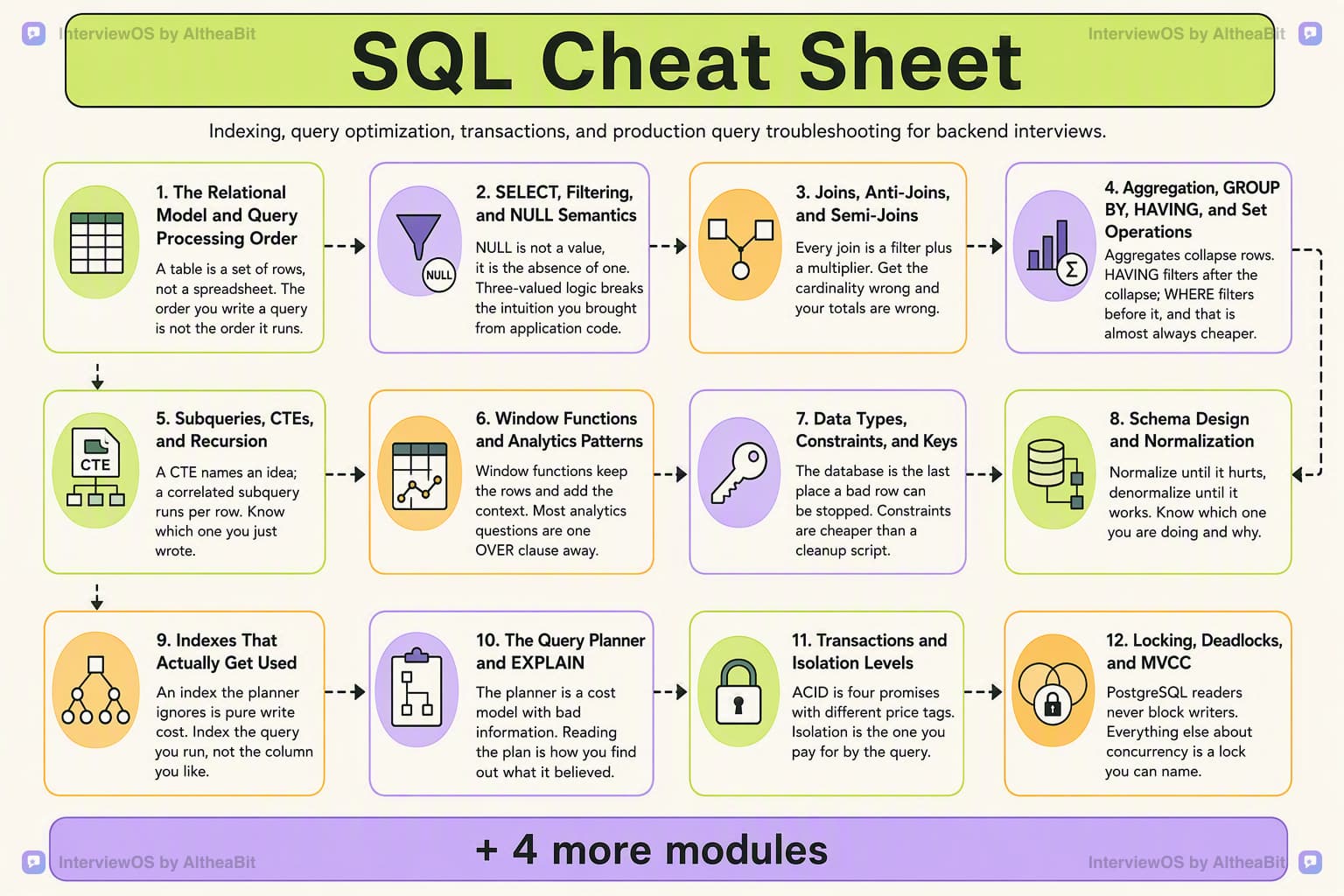
128 of 4 lessons
- 1What is a relation in the relational model, and why does it matter that a table has no inherent row order?Basicconceptual30 minIn writing
- 2In what order does the database logically process FROM, WHERE, GROUP BY, HAVING, SELECT, ORDER BY and LIMIT, and what bug does knowing that order prevent?Basicconceptual40 minIn writing
- 3SQL is declarative. What does that mean in practice for how you should reason about performance?Basicconceptual30 minIn writing
- 4How do candidate keys, primary keys, and surrogate keys differ, and how do you pick one for a new table?Basicconceptual40 minIn writing
- 5Why does SELECT return duplicates when relational theory says a relation is a set, and where does that leak into real queries?Intermediateconceptual35 minIn writing
- 6What separates DDL, DML, DCL and TCL statements, and which of them can you roll back in PostgreSQL?Basicconceptual30 minIn writing
- 7An interviewer asks you to explain what actually happens between typing a SELECT and getting rows back. How do you answer in two minutes?Scenarioscenario25 minIn writing
- 8Check your understanding of relations, keys, and logical query processing order.Basicconceptual15 minIn writing
- 9How do you combine BETWEEN, IN, LIKE and IS NULL in a WHERE clause, and which of them can silently disable an index?Basicpractical35 minIn writing
- 10Why does WHERE status != 'active' drop rows where status is NULL, and how do you write the filter you actually meant?Basicconceptual40 minIn writing
- 11When would you reach for COALESCE, NULLIF, or a column DEFAULT, and why is each a different decision?Intermediatepractical35 minIn writing
- 12How do you use CASE expressions to reshape a result set, and when does that logic belong in the application instead?Intermediatepractical35 minIn writing
- 13What does DISTINCT actually cost, and why is ORDER BY without a tiebreaker column a source of flaky pagination?Basicpractical40 minIn writing
- 14Why does OFFSET 100000 get slower the deeper a user pages, and how does keyset pagination fix it?Intermediatepractical45 minIn writing
- 15A report is missing rows that the user swears exist, and the WHERE clause looks correct. How do you find the cause?Scenariotroubleshooting25 minIn writing
- 16Check your understanding of filtering, NULL handling, ordering, and pagination.Basicconceptual15 minIn writing
- 17Walk through INNER, LEFT, RIGHT and FULL OUTER joins on the same two tables. What does each row set actually contain?Basicconceptual40 minIn writing
- 18Why does moving a condition from the ON clause to the WHERE clause turn a LEFT JOIN into an INNER JOIN?Intermediatepractical40 minIn writing
- 19A join to a one-to-many table doubled your revenue total. Explain the fan-out and how you would fix the aggregate.Intermediatetroubleshooting45 minIn writing
- 20How do you express "customers with no orders" three different ways, and which one would you ship?Intermediatepractical45 minIn writing
- 21When do you need a self-join, and how would you use one to find employees who earn more than their manager?Intermediatepractical40 minIn writing
- 22What are nested loop, hash, and merge joins, and what makes the planner choose each one?Advancedconceptual50 minIn writing
- 23You are asked at a whiteboard to report revenue per customer including customers who bought nothing this month. How do you write it?Scenariodesign25 minIn writing
- 24Check your understanding of join types, filter placement, fan-out, and join algorithms.Intermediateconceptual15 minIn writing
- 25What rule decides which columns are allowed in the SELECT list of a GROUP BY query, and why does PostgreSQL reject some that MySQL accepts?Basicpractical40 minIn writing
- 26When must a condition go in HAVING rather than WHERE, and why should you still push everything you can into WHERE?Basicconceptual35 minIn writing
- 27How do COUNT(*), COUNT(column) and COUNT(DISTINCT column) differ once NULLs are in the data?Intermediatepractical35 minIn writing
- 28How do you produce several conditional counts in a single pass using FILTER or CASE inside aggregates?Intermediatepractical45 minIn writing
- 29When is GROUPING SETS or ROLLUP worth the complexity compared with running several UNION ALL queries?Advancedpractical50 minIn writing
- 30What is the difference between UNION and UNION ALL, and when do INTERSECT and EXCEPT beat a join?Intermediatepractical40 minIn writing
- 31Design a single query that returns, per product category, total revenue, order count, and the share of orders that were refunded.Scenariodesign25 minIn writing
- 32Check your understanding of grouping, HAVING, aggregate NULL handling, and set operations.Intermediateconceptual15 minIn writing
- 33Where can a subquery legally appear in a statement, and what changes about it in each position?Basicpractical40 minIn writing
- 34What makes a subquery correlated, and why can one turn an otherwise fast query into a per-row loop?Intermediatetroubleshooting45 minIn writing
- 35How do EXISTS, IN and a JOIN differ in results and in plan, especially when the inner query can return NULL?Intermediatepractical45 minIn writing
- 36Are CTEs an optimization fence in PostgreSQL, and when would you use MATERIALIZED or NOT MATERIALIZED deliberately?Intermediatepractical45 minIn writing
- 37How would you use a recursive CTE to walk an org chart, and what stops it from looping forever on bad data?Advancedpractical55 minIn writing
- 38What problem does LATERAL solve that a plain subquery cannot, and how would you use it to fetch the three most recent orders per customer?Advancedpractical50 minIn writing
- 39You need the latest row per group across a 50 million row table. Compare the approaches you would consider and defend your pick.Scenariodesign25 minIn writing
- 40Check your understanding of subqueries, EXISTS, CTEs, recursion, and LATERAL.Intermediateconceptual15 minIn writing
- 41How does a window function differ from an aggregate, and why can you not use one in a WHERE clause?Intermediateconceptual45 minIn writing
- 42What does the frame clause (ROWS versus RANGE) actually change, and what is the default frame you get when you omit it?Advancedpractical50 minIn writing
- 43When would you choose ROW_NUMBER over RANK or DENSE_RANK, and how does the tiebreaker affect reproducibility?Intermediatepractical40 minIn writing
- 44How do you compute a running total and a seven-day moving average over daily revenue in one pass?Advancedpractical50 minIn writing
- 45How would you delete duplicate rows that have no unique key, keeping only the earliest of each group?Intermediatepractical45 minIn writing
- 46How would you find each user's longest streak of consecutive active days, and how does the same technique power a cohort retention table?Advanceddesign60 minIn writing
- 47An interviewer asks for month-over-month revenue growth per region as a single query. Talk through your solution.Scenariodesign25 minIn writing
- 48Check your understanding of windows, frames, ranking, and analytics patterns.Advancedconceptual15 minIn writing
- 49Why should money never be stored as a float, and what would you use in PostgreSQL instead?Basicconceptual35 minIn writing
- 50Does VARCHAR(255) buy you anything over TEXT in PostgreSQL, and where does collation change query results?Basicconceptual35 minIn writing
- 51What is the difference between timestamp and timestamptz, and how do you store an event that happened in another time zone?Intermediatepractical45 minIn writing
- 52When is a JSONB column the right call instead of a proper table, and what do you give up by choosing it?Intermediatedesign45 minIn writing
- 53Which constraints would you put on an orders table, and what does each one prevent that application code would miss?Intermediatepractical45 minIn writing
- 54What does ON DELETE CASCADE actually do, and when is it a trap rather than a convenience?Intermediatedesign45 minIn writing
- 55You inherit a table where every column is TEXT and nullable. How do you argue for and stage a fix?Scenariodesign25 minIn writing
- 56Check your understanding of types, time zones, JSONB, and constraints.Intermediateconceptual15 minIn writing
- 57Explain 1NF, 2NF and 3NF using a real orders table, and say what each step actually removed.Basicconceptual45 minIn writing
- 58What would justify duplicating a column into a second table, and how do you keep the copy correct afterwards?Advanceddesign50 minIn writing
- 59How do you model one-to-many and many-to-many relationships, and what belongs on a join table besides the two keys?Intermediatedesign45 minIn writing
- 60What are the real costs of a deleted_at soft-delete column, and what would you use instead for auditable history?Intermediatedesign45 minIn writing
- 61How would you isolate tenants in a shared database, and what makes a tenant_id column safer or riskier than a schema per tenant?Advanceddesign55 minIn writing
- 62A product manager wants user-defined fields. Compare EAV, JSONB, and adding columns, and pick one.Advanceddesign50 minIn writing
- 63Design the schema for a job board with applications, resumes, and interview stages. Defend your key choices.Scenariodesign25 minIn writing
- 64Check your understanding of normalization, relationships, history, and multi-tenancy.Intermediateconceptual15 minIn writing
- 65What does a database index actually do, and why shouldn't every column be indexed?Basicconceptual5 min
- 66What does a B-tree index look like on disk, and why does that structure make range scans cheap but random inserts expensive?Intermediateconceptual45 minIn writing
- 67You have a query filtering on tenant_id and sorting by created_at. What column order do you use for the composite index, and why?Advancedpractical50 minIn writing
- 68What makes an index-only scan possible in PostgreSQL, and what does INCLUDE add that a wider index key does not?Advancedpractical50 minIn writing
- 69When is a partial index the right answer, and how would you index lower(email) for a case-insensitive lookup?Advancedpractical45 minIn writing
- 70When would you reach for GIN, GiST, BRIN or a hash index instead of a B-tree?Advancedconceptual50 minIn writing
- 71You added the index the slow query needed and nothing got faster. Walk through why the planner might still ignore it.Scenariotroubleshooting25 minIn writing
- 72Check your understanding of B-trees, composite order, covering indexes, and index types.Advancedconceptual15 minIn writing
- 73How does a cost-based optimizer pick a plan, and what inputs is it working from?Advancedconceptual50 minIn writing
- 74How do you read an EXPLAIN plan tree, and which numbers do you look at first?Intermediatepractical50 minIn writing
- 75What do EXPLAIN ANALYZE and BUFFERS tell you that plain EXPLAIN cannot, and when is running it in production unsafe?Advancedpractical45 minIn writing
- 76The planner estimates 12 rows and gets 400,000. What is wrong, and how do you fix it?Advancedtroubleshooting50 minIn writing
- 77Why is a sequential scan sometimes faster than an index scan, and at roughly what selectivity does that flip?Intermediateconceptual45 minIn writing
- 78Which common ways of writing a WHERE clause stop an index from being used, and how do you rewrite them?Advancedtroubleshooting50 minIn writing
- 79An interviewer hands you an EXPLAIN ANALYZE output with a nested loop over 2 million rows. What do you say?Scenariotroubleshooting25 minIn writing
- 80Check your understanding of planning, EXPLAIN output, statistics, and scan choices.Advancedconceptual15 minIn writing
- 81What do atomicity, consistency, isolation and durability each guarantee, and which one do developers most often assume they have but do not?Basicconceptual40 minIn writing
- 82Where should a transaction begin and end in a web request, and what goes wrong when it wraps an HTTP call to a payment provider?Intermediatepractical45 minIn writing
- 83Define dirty read, non-repeatable read, phantom read and write skew, and give a business example of each.Intermediateconceptual45 minIn writing
- 84How would you choose a transaction isolation level for a feature that decrements inventory stock on checkout, and what could go wrong at the default level?Advanceddesign5 min
- 85Which anomalies does each PostgreSQL isolation level prevent, and why is PostgreSQL REPEATABLE READ stricter than the standard requires?Advancedconceptual50 minIn writing
- 86What do savepoints let you do inside a transaction, and what is the cost of using one per loop iteration?Intermediatepractical40 minIn writing
- 87Design the transaction boundaries for a checkout that charges a card, writes an order, and decrements stock.Scenariodesign25 minIn writing
- 88Check your understanding of ACID, anomalies, isolation levels, and transaction scope.Advancedconceptual15 minIn writing
- 89How does MVCC let a reader and a writer touch the same row at once, and what is stored to make that work?Advancedconceptual50 minIn writing
- 90Which lock does a plain UPDATE take, and which statements conflict with it?Advancedconceptual45 minIn writing
- 91How would you build a job queue table using SELECT ... FOR UPDATE SKIP LOCKED, and why is that better than a status flag alone?Advancedpractical50 minIn writing
- 92Two transactions deadlocked in production. How do you read the log entry and stop it happening again?Advancedtroubleshooting50 minIn writing
- 93When would you use a version column instead of a row lock, and what does the client have to do differently?Advanceddesign45 minIn writing
- 94Why does one idle-in-transaction connection stop autovacuum from cleaning up an entire database?Advancedtroubleshooting50 minIn writing
- 95Writes to one hot table are queueing behind each other during peak traffic. Walk through your investigation.Scenariotroubleshooting25 minIn writing
- 96Check your understanding of MVCC, lock modes, deadlocks, and vacuum.Advancedconceptual15 minIn writing
- 97You have a slow endpoint and no idea which statement is at fault. How do you find it with pg_stat_statements and query logs?Intermediatepractical45 minIn writing
- 98What is the N+1 query problem, and how do you fix it without just caching the result?Intermediatepractical5 min
- 99A query takes 20ms and the endpoint takes 2 seconds. Where has the time gone, and how do you prove it?Advancedconceptual45 minIn writing
- 100Why does a serverless app exhaust database connections, and what does a pooler in transaction mode change?Advancedtroubleshooting50 minIn writing
- 101A query that joins three tables and was fast in staging is timing out in production under real traffic. Walk through how you'd diagnose it.Scenarioscenario5 min
- 102When is a materialized view the right cache, and how do you keep it fresh without blocking readers?Advanceddesign50 minIn writing
- 103The database CPU is pinned at 100% and everything is slow. What do you look at, in what order?Scenariotroubleshooting25 minIn writing
- 104Check your understanding of query profiling, pooling, N+1, and caching strategies.Advancedconceptual15 minIn writing
- 105What actually starts to hurt as a table grows past a few hundred million rows?Advancedconceptual45 minIn writing
- 106How would you partition an events table by month in PostgreSQL, and what does partition pruning require from your queries?Advanceddesign55 minIn writing
- 107How do you choose between range, list and hash partitioning, and what makes a bad partition key?Advanceddesign50 minIn writing
- 108Design a retention policy that deletes two years of old rows without locking the table for hours.Advanceddesign50 minIn writing
- 109How do you update 50 million rows without holding one enormous transaction, and how do you make the job resumable?Advancedpractical50 minIn writing
- 110When do you reach for read replicas, and what breaks the first time you serve a read from a lagging one?Advanceddesign55 minIn writing
- 111An events table grows by 200 million rows a month and queries only ever look at the last 30 days. Design the storage.Scenariodesign25 minIn writing
- 112Check your understanding of partitioning, retention, batching, and replicas.Advancedconceptual15 minIn writing
- 113Why must an applied migration never be edited, and what do you do instead when it was wrong?Intermediatepractical40 minIn writing
- 114Which ALTER TABLE statements take an ACCESS EXCLUSIVE lock, and why did adding one NOT NULL column take the site down?Advancedtroubleshooting50 minIn writing
- 115Walk through renaming a column with zero downtime using the expand-and-contract pattern.Advanceddesign50 minIn writing
- 116What does CREATE INDEX CONCURRENTLY buy you, and what do you do when it leaves an invalid index behind?Advancedpractical45 minIn writing
- 117How do you backfill a new column across 100 million rows while the application keeps writing?Advancedpractical50 minIn writing
- 118A migration has half applied in production. Do you roll back or roll forward, and what decides that?Advanceddesign45 minIn writing
- 119You must split one table into two and ship it without a maintenance window. Plan the sequence of releases.Scenariodesign25 minIn writing
- 120Check your understanding of DDL locking, expand-contract, concurrent indexes, and backfills.Advancedconceptual15 minIn writing
- 121How does SQL injection actually work, and why do parameterized queries stop it when escaping does not?Basicconceptual45 minIn writing
- 122You need a user-chosen sort column. How do you build that query without opening an injection hole?Advancedpractical45 minIn writing
- 123What privileges should the application role actually have, and why should it not own its own tables?Advanceddesign50 minIn writing
- 124How does PostgreSQL row-level security enforce tenant isolation, and what does it cost you in plans and testing?Advanceddesign55 minIn writing
- 125How would you audit access to a table of personal data, and where does encryption at rest stop helping?Advanceddesign50 minIn writing
- 126Take a production database that has degraded over six months — slow queries, table bloat, a risky pending migration, and a tenant-isolation gap — and produce a prioritized remediation plan you can defend.Scenariodesign240 minIn writing
- 127A code review shows a query built by string concatenation from a request parameter. How do you assess the blast radius and fix it?Scenariotroubleshooting25 minIn writing
- 128Check your understanding of injection, privileges, row-level security, and auditing.Advancedconceptual15 minIn writing